The city of Vysh stands on an iron Lid over the Well. Once per generation, a Warden is chained and lowered into the depth, supposedly to feed what lives below. Former executioner Mott Garro takes his daughter's place. The chain cannot bring him back: only down.
Problem
Combine weighty action, an endless RPG, idle progression, co-op, and complete offline play without splitting the game in two.
What we built
A deterministic Rust simulation, content packs, one UI/3D stack, and an asset pipeline with measurable gates.
Result
One world and one loop: fight, enter the Doze, return to the Lid, and continue the same descent.
One mechanic at the center
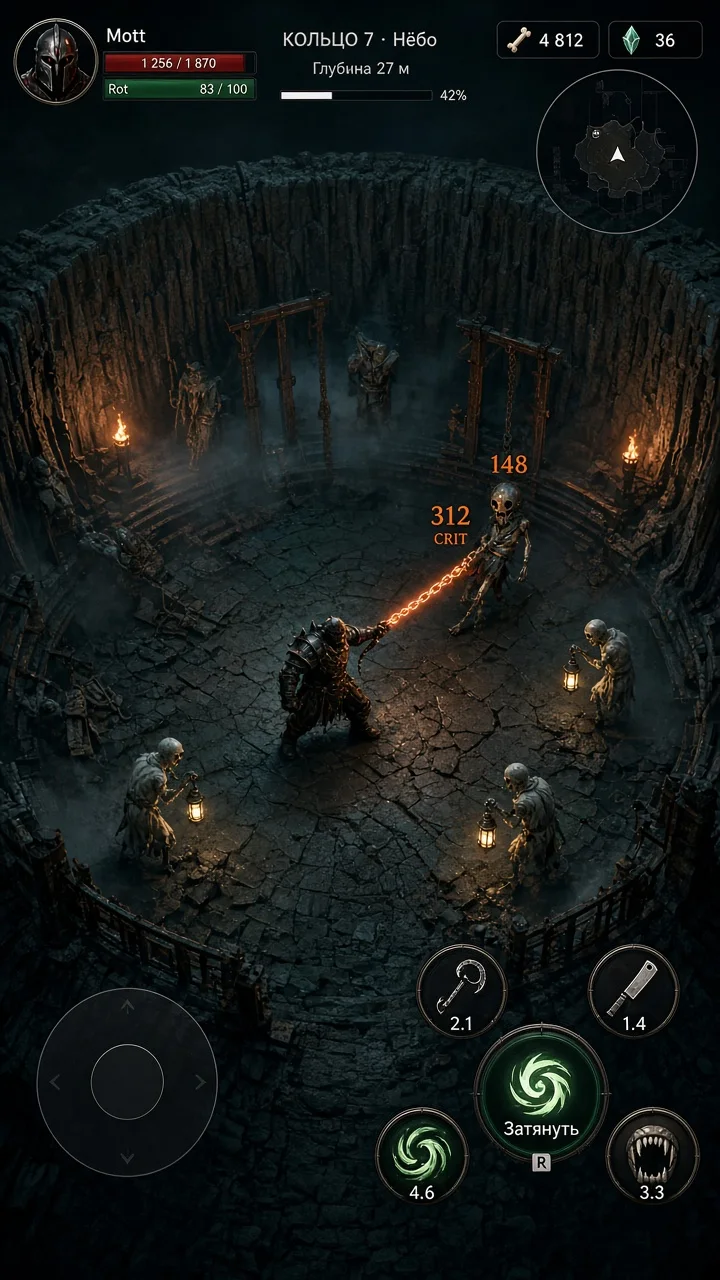
The chain hook is not an extra ability; it is the center of combat. It pulls enemies, catches pillars, tears targets from ledges, and holds them for co-op combos. Cleaver controls close range, Rot trades health for damage, and Devour turns corpses into permanent maximum health.
The map grows ring by ring. The Palate is built from city debris, the Gullet from shafts and thousands of old chains, the Belly holds acid lakes and swallowed buildings, and the Dream reflects Vysh upside down. At ring 60 a choice changes the endless mode.
Hollowdeep concept art
Idle without a separate game
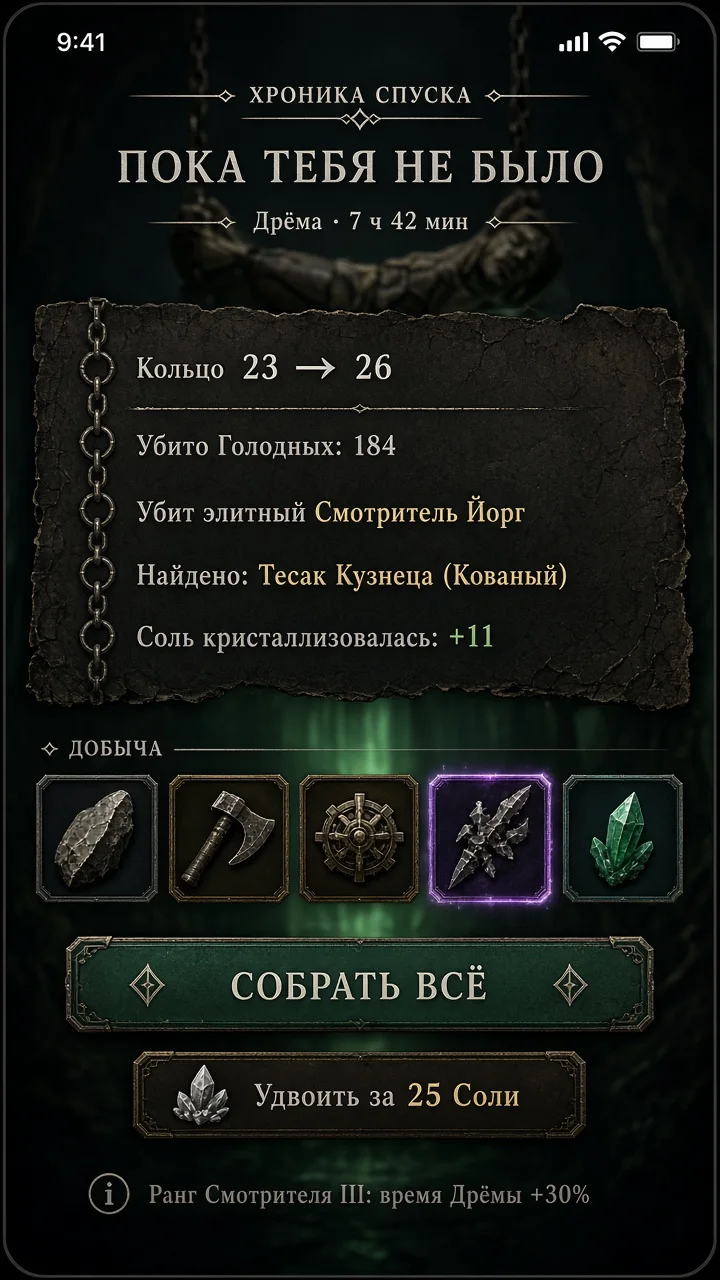
When the player leaves, Mott does not become a number in another mode. The chain keeps pulling him down, the same simulation calculates the Doze, and the returning Chronicle reports rings crossed, enemies killed, loot found, and Salt crystallized.
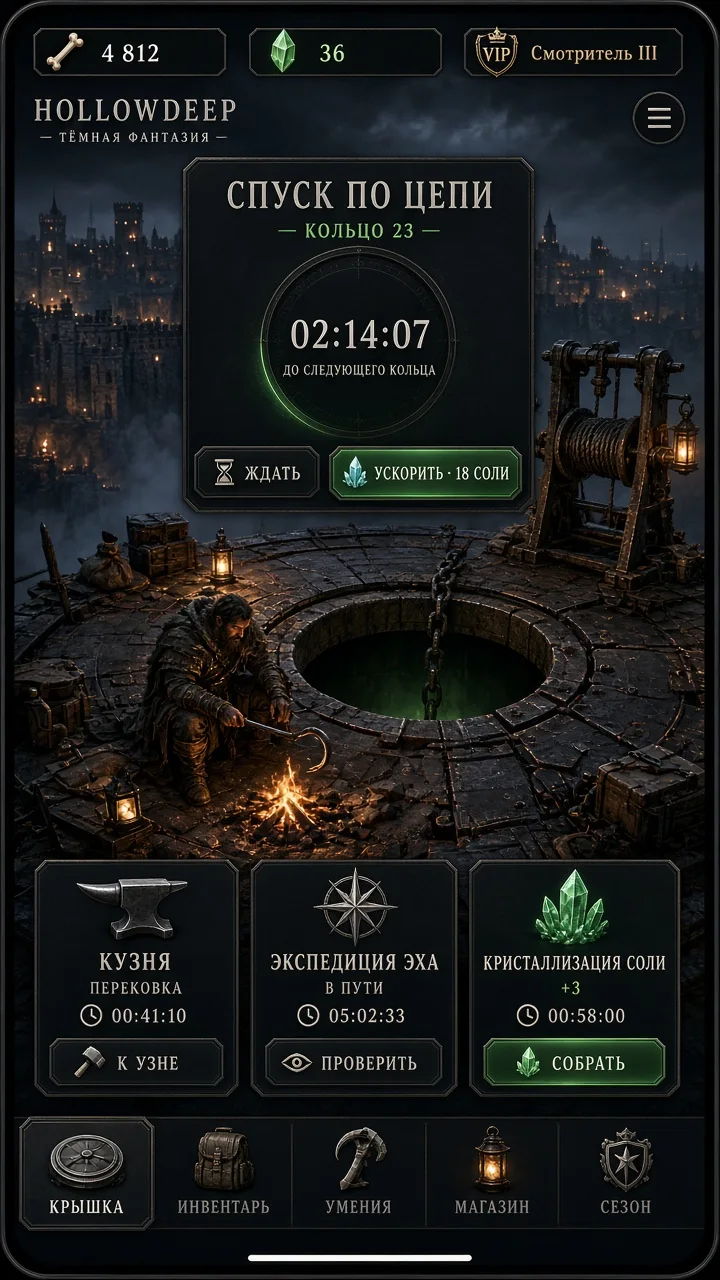
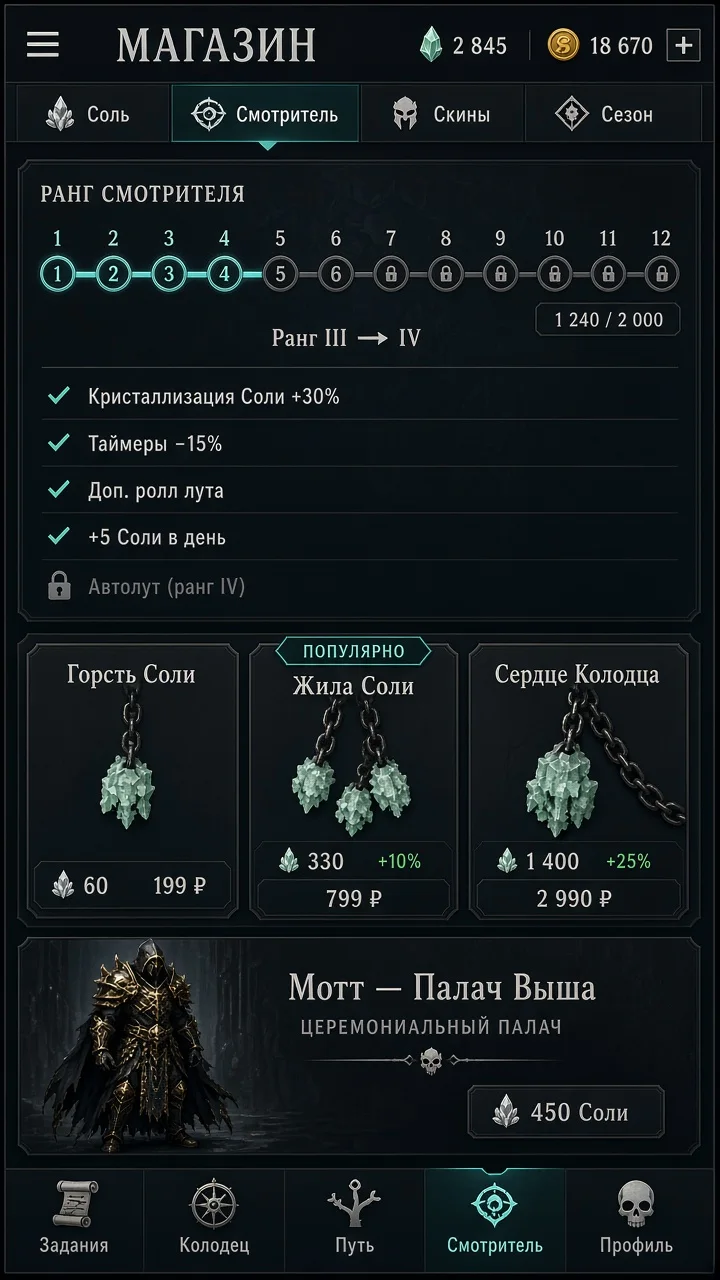
The Lid is the hub: the Warden's fire, winch, and chain sit beside the Forge, Echo Expedition, and Salt Crystallization timers. Time can pass naturally or be accelerated, but money buys time and cosmetics, not victory over another player.
Solo, Tether, and offline use one path
Hollowdeep is designed around one deterministic Rust simulation. Solo is a session with one slot. The Tether is up to four Wardens exchanging lockstep commands inside the same combat. Offline play keeps rings, loot, timers, inventory, and the soft-currency store available; the journal synchronizes when connectivity returns.
Content stays outside game logic: glTF models, RON definitions, tilesets, items, monsters, economy, and story triggers live in packs with stable IDs. A new season, biome, or enemy does not require another client-side branch.
Why it looks this way
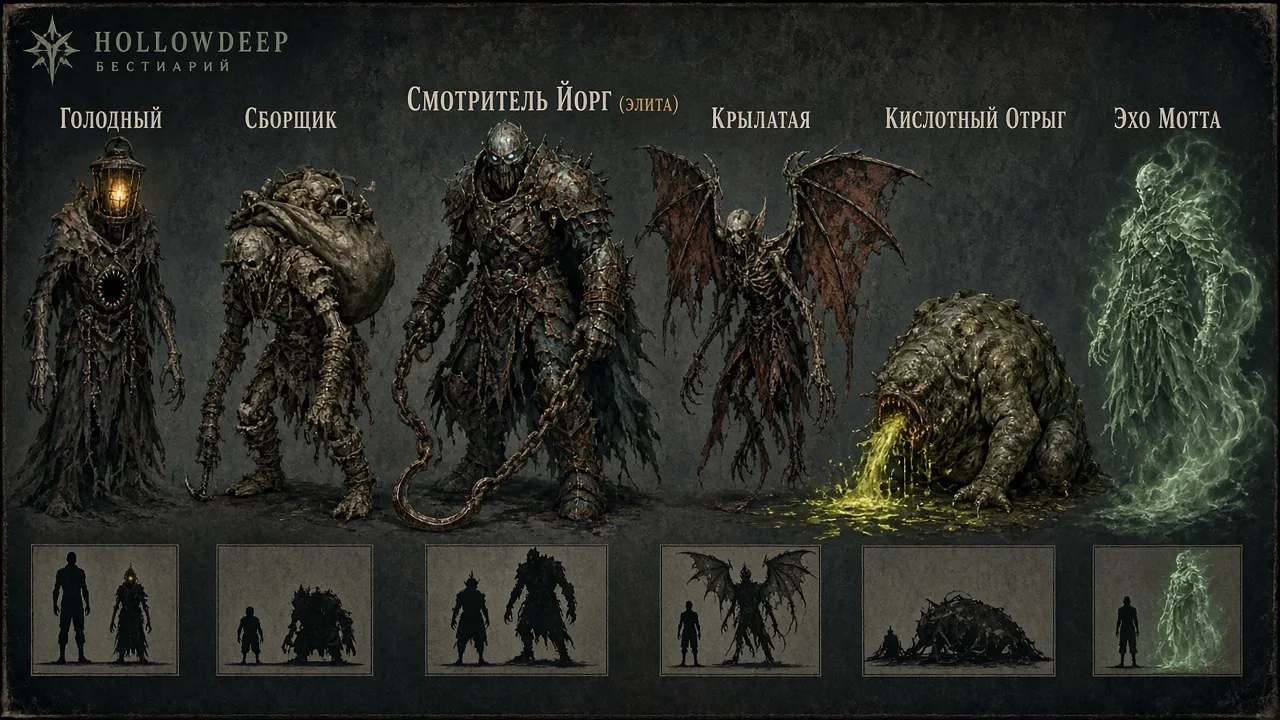
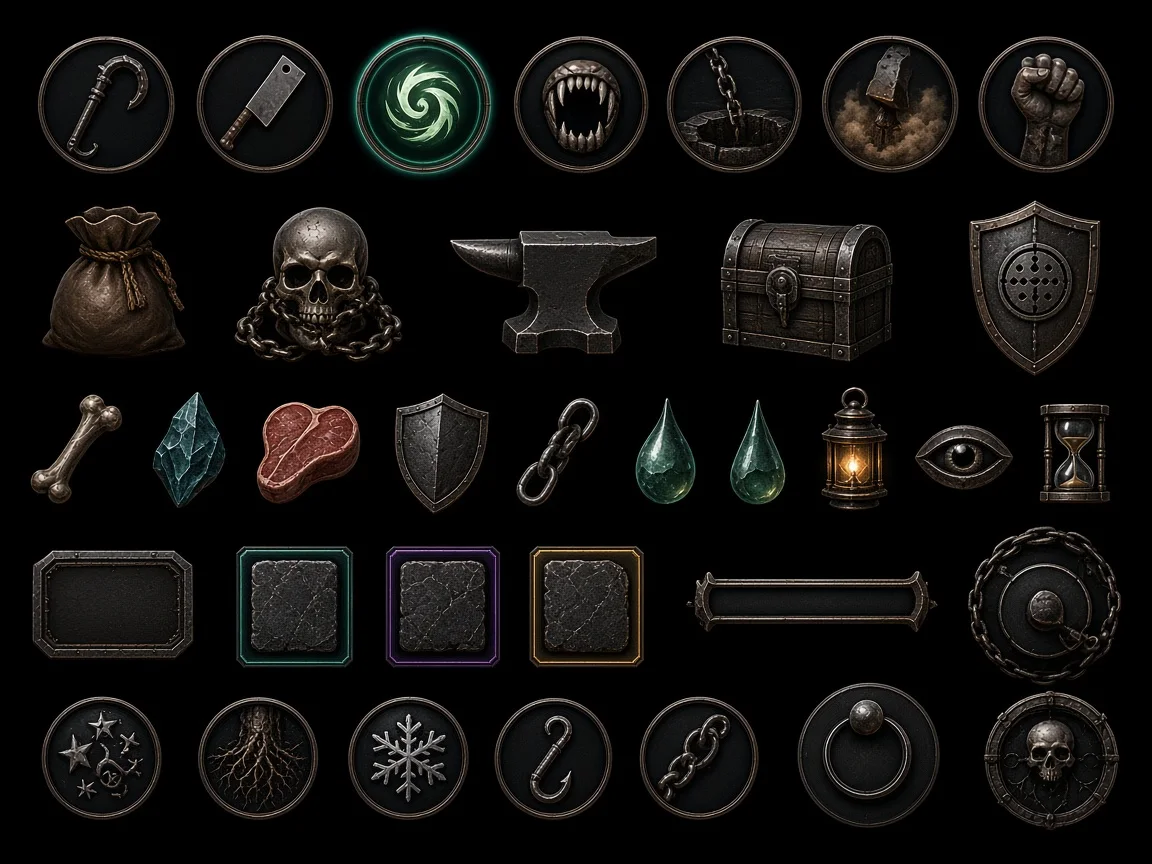
The visual language uses three families: cold teal for stone and shadow, rust and amber for iron and fire, and sickly green for Rot, Salt, and the Well. Chains repeat from combat and lore into UI frames. On a six-inch screen silhouette matters more than fine texture, so every enemy is identified by mass, posture, and one luminous accent.
What the concepts already test
The images are not mood boards only. Combat art tests camera and control distances; the Lid tests idle hierarchy; the Chronicle tests return flow; the bestiary tests six distinct silhouettes; the UI kit keeps icons, frames, and currencies in one material language.
Hollowdeep is our full-cycle proving ground: worldbuilding and concept art, deterministic simulation, asset pipeline, iOS host, and backend services. We apply the same methods to custom game development.Need a game with its own identity?
We can evaluate the idea, build a vertical slice, or design the complete production pipeline.
Custom game development: from concept to an iOS buildHow we build custom games: core loop, art direction, deterministic simulation, content packs, and one codebase for iPhone, iPad, and Mac.
 Our own AI, all the way down: engine, memory, agent — and the night it learns
In five and a half months we built a complete AI stack of our own in Rust: an inference engine faster than llama.cpp, an agent runtime with memory and task preemption, a benchmark harness and a nightly training loop with proof. Numbers from our benchmarks — and what of it your business needs.
 How to choose a VPN in 2026: a no-nonsense checklist
Jurisdiction, logging, protocols, speed and honest pricing — what actually matters when you pick a VPN, and what is pure marketing.