Custom game development is not about drawing a few screens and attaching a store. The hard part starts when a prototype must become a product: survive updates, work offline, accept new content without code rewrites, and behave consistently across devices.
Problem
A prototype is easy to build quickly and hard to turn into a product that survives seasons, offline play, co-op, and new platforms.
What we built
We separated simulation, presentation, content, and the platform host, then gave every boundary a testable contract.
Result
One extensible codebase for iPhone, iPad, and Mac, with new entities and locations delivered as data packs.
Start with a testable promise
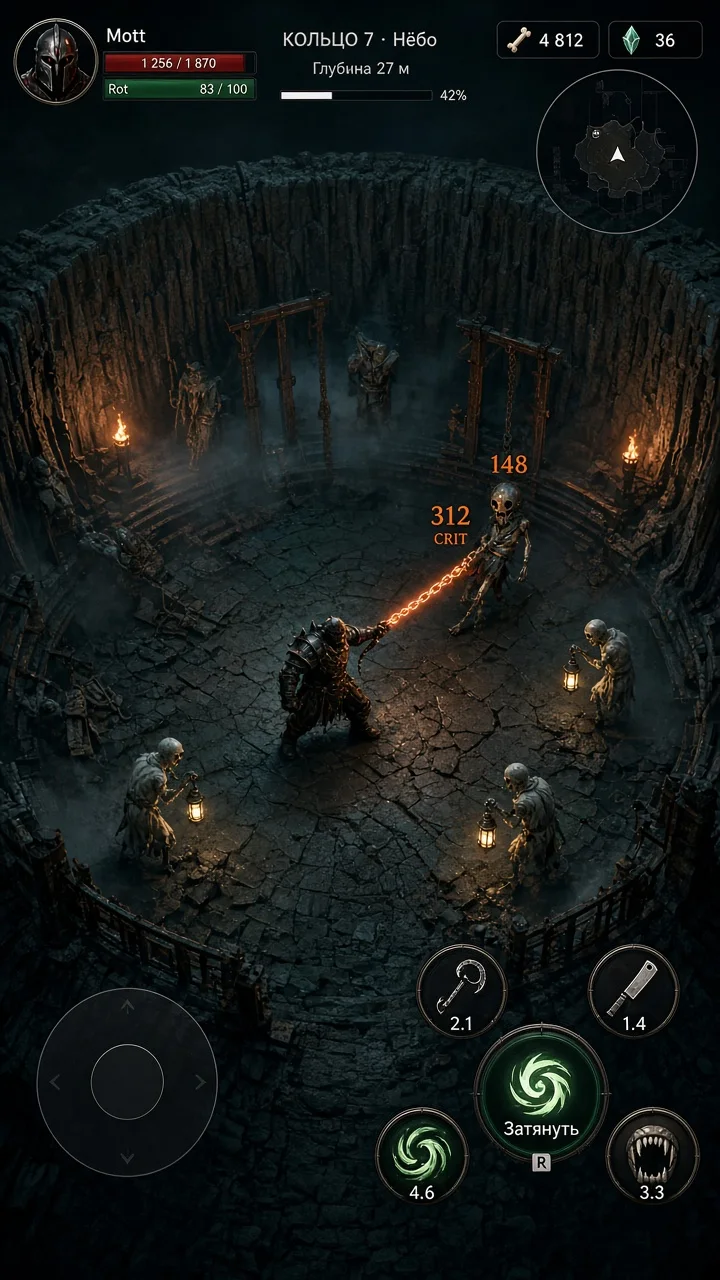
We do not begin with an engine choice. We begin with one testable gameplay promise. For Hollowdeep it is simple: within 60 seconds, the chain hook must feel heavy, risky, and controllable. That decision drives camera, arena dimensions, enemy silhouettes, controls, sound, and the first quality gate.
Before production we define the core loop, economy, visual bible, target platforms, performance budgets, and acceptance criteria. Concept art is not decoration: it fixes frame composition, UI hierarchy, palette, and the asset list.
Architecture that survives the prototype
Hollowdeep keeps its simulation in a separate Rust crate with no renderer, filesystem, or wall clock dependency. Every state change is a serializable command, randomness uses separate seeded streams, and a run can be replayed from its journal. One path serves solo play, offline play, and co-op.
Content is data: RON definitions, glTF models, textures, audio, and stable string IDs. A new monster, item, tileset, or season arrives as a pack. UI runs on our 0xd-ui stack, 3D on velox, while the iOS host receives versioned events for StoreKit, Game Center, saves, and sharing.
What a custom engagement can include
Product and game brief, core loop, and vertical slice.
Narrative, economy, and live ops without pay-to-win.
Concept art, UI system, 3D assets, VFX, and sound.
Client, backend integrations, saves, and offline sync.
Target-device performance, testing, and builds.
Analytics and measurable soft-launch gates.
How we accept the result
“Done” must be observable. Simulation passes headless tests, UI passes golden tests, content passes budget and reference validation, and builds run on target hardware. For critical screens we place the concept and the real frame side by side and keep iterating until every difference is intentional.
When this approach is justified
It is most useful for RPG, roguelike, idle, and co-op games where systems overlap and content keeps growing. A short ad mini-game can use a simpler stack. For a title expected to live through seasons, the cost of an early architectural mistake quickly exceeds the cost of a sound foundation.
We can join at the idea stage, audit an existing project, build a vertical slice, or take full ownership of game production with acceptance criteria agreed before development starts.Discuss your game
Tell us the genre, target platforms, current stage, and what should count as a finished result.
 Our own AI, all the way down: engine, memory, agent — and the night it learns
In five and a half months we built a complete AI stack of our own in Rust: an inference engine faster than llama.cpp, an agent runtime with memory and task preemption, a benchmark harness and a nightly training loop with proof. Numbers from our benchmarks — and what of it your business needs.
 Security assessment vs pentest: three different jobs
Assessment, pentest and scan are three jobs. Zero Day Labs takes authorized work on a written scope — and runs it on our own tools, not a rented scanner PDF.
 How to choose a VPN in 2026: a no-nonsense checklist
Jurisdiction, logging, protocols, speed and honest pricing — what actually matters when you pick a VPN, and what is pure marketing.