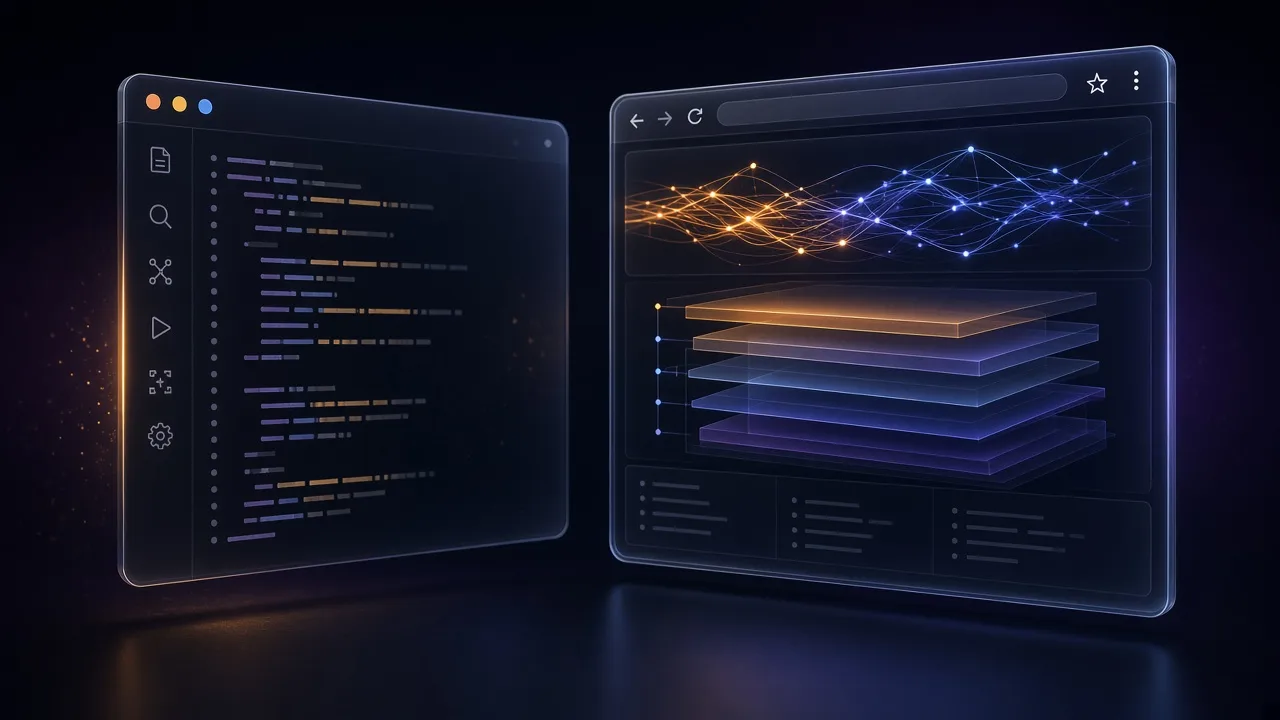
The usual authorized web review looks like this: editor in one space, three Chromes in another, a scratch file for notes, a screenshot folder that never gets attached to the ticket. Findings live in the gap. We got tired of the gap and put the browser in the editor.
This is review and QA automation on your app — staging, a local build, a scope you already have in writing. It is not a scanner and not a kit for touching other people's sites.
What "browser in the editor" actually means
Forge IDE is not a theme on Zed. It is a deep fork: our AI Studio orchestrator, UIDE (local vectors, documents, graph on RocksDB), Whisper on-device, and a WebDriver integration we speak through our own MCP/JSON-RPC.
From the same window you already use for the code you can:
- drive the page and take screenshots that belong to the file, not to
/Desktop; - inspect the DOM without losing the Rust or TypeScript buffer;
- watch the network for the request you just shipped;
- run the audits you already agreed in the checklist.

The point is not "AI will pentest the site by itself". The point is that when you order a web review from us — or run one inside the house — the tester stops context-switching every time the page and the handler disagree.
Where UIDE and skills earn their keep
UIDE is the local store. Review notes, previous DOM dumps, the checklist for this app — searchable next to the repo, not in a cloud doc the contractor cannot open on the plane.
Declarative skills are JSON behaviours in that store: "open the billing page, screenshot the empty state, attach it to the finding template". You write them once. The orchestrator chains them. They do not get a new capability unless you put it in the file.
If a step must run as an agent with tools, that is AGI Core's sandbox — grants, not hope.
A pass that stays inside the rails
- Scope and environment (staging URL, test user) written down.
- Open the repo in Forge. Drive the agreed paths. Screenshot what the ticket will need.
- File the finding next to the handler, not in a chat screenshot.
The vocabulary for "is this even a pentest?" is in assessment vs pentest. If the page under test is locale-sensitive, fix the clock first — timezone leaks.
What you can order from us
Zero Day Labs takes authorized security work — we use the same products described in this series, not a rented scanner PDF.
You can write to [email protected] or the contact form and ask for:
- a security assessment (map of assets, controls, residual risk);
- an authorized pentest on a written scope;
- a web application review (from the editor: DOM, network, evidence);
- a review of agent and tool isolation (what the agent is allowed to call);
- help making test fixtures honest (locale, timezone, exit address) so the report describes your system, not the tester's laptop.
Say which job you want, the scope, and what "done" looks like. We reply with a concrete proposal — same rule as the rest of the site.